
New York Work-Zone Accidents: What Should Be Included in the Accident Record?
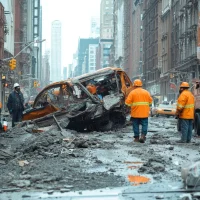
Work zones can change a familiar New York road almost overnight. Travel lanes shift, concrete barriers narrow the roadway, temporary signs replace normal traffic patterns, and construction vehicles move between active traffic and closed work areas. Flaggers may also control traffic through sections where the usual signals or lane markings no longer apply.
When an accident occurs, those temporary conditions become part of the accident record. They can help explain where the vehicles were traveling, how much roadway was available, and what traffic controls were in place. Many of those details disappear as construction continues, making an accurate record especially important after a New York work-zone crash.
When a Work-Zone Accident Requires an MV-104
A construction or work-zone accident follows the same New York reporting standard as other motor vehicle accidents.
Under New York Vehicle and Traffic Law § 605, a driver must file Form MV-104 within 10 days when an accident results in personal injury, death, or property damage to any one person exceeding $1,000.
You can review the statute here:
New York Vehicle and Traffic Law § 605
Construction equipment, temporary traffic controls, and changing road conditions do not create a separate DMV filing rule. They affect the facts that need to be accurately recorded when a report is required.
Temporary Lane Configurations Can Change the Entire Scene
Work zones frequently move traffic away from its normal path.
A three-lane roadway may narrow to two lanes. Traffic may cross temporary pavement markings, shift toward a shoulder, or travel closer to opposing vehicles than it normally would.
The accident record should identify the direction of travel and temporary lane arrangement as clearly as possible. Wider photographs showing lane shifts, merge areas, vehicle positions, and recognizable landmarks can provide context that may no longer exist after construction advances.
Barriers and Cones Define the Available Roadway
Concrete barriers, barrels, cones, and other channelizing devices determine where vehicles are expected to travel.
Their placement may explain why lanes were unusually narrow, why two vehicles were traveling close together, or why a driver had little room to move away from another vehicle.
A displaced cone or damaged barrier may also help identify the area where the collision occurred. Recording the location of these devices can be more useful than trying to reconstruct their placement later.
Temporary Signs and Traffic Controls Matter
Construction zones often rely on warning and directional signs that are present only while work is underway.
Drivers may encounter reduced speed notices, lane-closure warnings, detour signs, temporary stop controls, or instructions directing traffic around equipment. A permanent intersection may also operate differently during construction.
The accident record should reflect the traffic controls that were actually in place, including signs encountered while approaching the crash location rather than only those beside the point of impact.
Flaggers and Construction Workers May Have Seen the Crash
Some New York work zones rely on flaggers to alternate traffic, stop vehicles, or allow construction equipment to cross active lanes.
A flagger may have observed the vehicles immediately before impact or know what instructions were being given at the time. Other construction workers may also have been positioned where they could see the collision.
Names, employer information, and available contact information can help identify these witnesses if questions arise later.
Construction Vehicles Need to Be Identified Accurately
Dump trucks, excavators, paving equipment, utility vehicles, and contractor trucks often operate close to ordinary traffic.
Several similar vehicles may be present at the same project. A description such as “construction truck” may provide little help later.
Company markings, license plates, unit numbers, vehicle type, and the location of the equipment can distinguish the vehicle involved from others working at the site.
Road Conditions Inside the Work Zone May Be Temporary
The roadway itself can be substantially different inside a construction area.
Temporary asphalt, steel plates, gravel, uneven pavement, standing water, abrupt elevation changes, and incomplete lane markings may affect how vehicles move through the work zone.
The location of those conditions matters. A close photograph of a steel plate or pavement defect provides limited context unless the record also shows where it was positioned in relation to the active traffic lanes.
Photographs Can Preserve the Work Zone Before It Changes
Work-zone accident scenes can change faster than ordinary roadways.
Construction may resume within hours. Equipment moves, barriers are repositioned, temporary signs are removed, and traffic may be shifted into another lane.
A useful set of photographs should capture the overall roadway configuration as well as specific details connected to the collision. Vehicle positions and damage, temporary traffic controls, construction equipment, roadway surfaces, and nearby landmarks can collectively preserve the scene without relying on any single image.
Police Reports Can Add Details From the Scene
Police responding to the accident may record information that becomes difficult to obtain later.
The report can identify drivers, vehicles, witnesses, road conditions, construction equipment, and the location of the crash. It may also contain information needed to complete other accident records.
Keeping the police report number with the driver’s photographs, repair information, and notes provides another reference if the work zone changes before the accident is fully reviewed.
Describing the Work Zone on the MV-104
A temporary traffic pattern can make the accident location difficult to describe on Form MV-104.
The roadway may have temporary lanes that do not correspond with the permanent layout. Normal lane numbers may no longer make sense, and an intersection may be operating under temporary controls.
Direction of travel, nearby streets, construction signs, barriers, fixed landmarks, and other identifiable features can help describe where the collision occurred without guessing about a lane configuration that no longer exists.
The Accident Scene May Change Before the Filing Deadline
Construction activity can continue immediately after a collision. By the time an accident report is prepared, the roadway may already look different.
That makes information collected near the time of the crash particularly valuable. It gives the driver a factual basis for describing temporary conditions even after the project has moved into another phase.
Failure to file when required can create separate DMV consequences. New York Vehicle and Traffic Law § 510 governs the DMV’s authority concerning suspension and revocation of licenses and registrations.
You can review the statute here:
New York Vehicle and Traffic Law § 510
Contact a New York Automobile Accident Attorney in Your Area
If you were injured in a New York work-zone accident, an attorney can review the circumstances of the collision, available records, insurance issues, and any legal questions involving the crash.
Temporary traffic patterns can disappear quickly after an accident. Keeping photographs, witness information, police records, and details about the work zone together can make the accident easier to document accurately. If an MV-104 is required, Report A Crash can help you prepare and file the required New York accident report accurately and on time.

